
 1 hour ago
1
China has called for a permanent African seat on the United Nations Security Council to strengthen the continent’s representation in global decision-making.
Chinese Foreign Minister Wang Yi made the appeal at the ongoing 2026 Global Governance Forum in Xiong’an New Area, Hebei Province.
Wang said the security council reform should prioritise developing countries, particularly Africa, while creating greater opportunities for small and medium-sized nations to influence international affairs.
He said the reform should address Africa’s aspirations through special arrangements, reflecting the growing influence of developing countries in global governance.
According to him, giving greater participation to developing countries will help correct historical imbalances and introduce broader perspectives into international decision-making.
China’s position aligns with its advocacy for a more inclusive international order, although Wang did not identify prospective African permanent members or explicitly address the extension of veto powers.
The News Agency of Nigeria (NAN) reports that security council has 15 members, comprising five permanent members and 10 non-permanent members elected by the UN General Assembly for two-year terms.
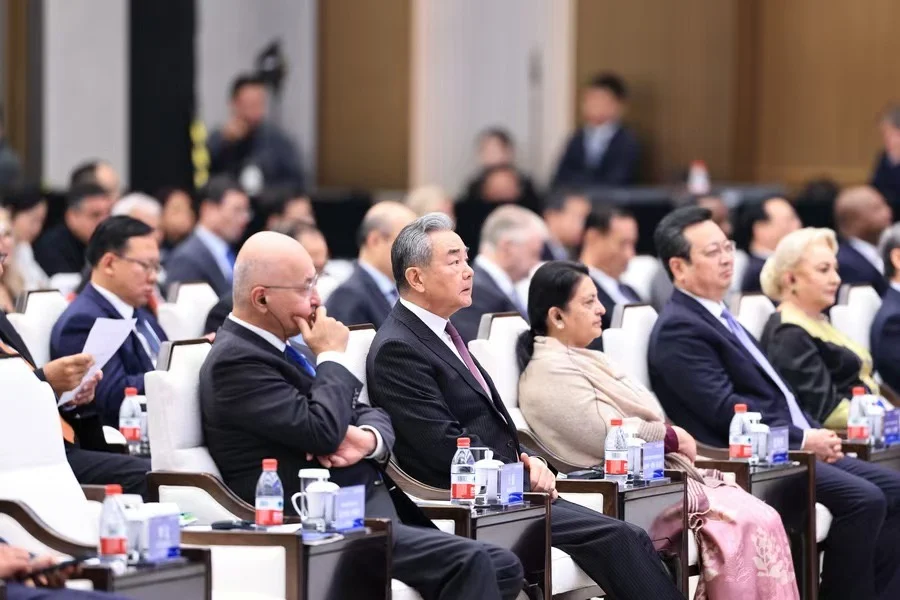 Participants drawn from across the world at the event
China, France, Russia, the United Kingdom and the United States currently hold the permanent seats and possess veto powers, while Africa currently has three elected seats without permanent representation.
Substantive resolutions require at least nine affirmative votes and no veto from any permanent member, giving the five countries considerable influence over international peace and security decisions.
Africa’s common position seeks at least two permanent seats with the same prerogatives as existing permanent members, including veto rights if retained, alongside five non-permanent seats.
The continent’s advocates cite its geographical size, development needs and strategic resources, including approximately 30 per cent of global mineral reserves, as reasons for stronger representation.
Reforming the security council requires a UN Charter amendment approved by two-thirds of general assembly members and ratified by two-thirds of UN member states, including all five permanent members.
The three-day forum, hosted by the Chinese People’s Institute of Foreign Affairs, attracted international participants from more than 90 countries, with Xiong’an showcasing China’s approach to long-term planning, innovation and green development. (NAN)
Edited by Isaac Aregbesola/Deborah Coker










 English (US) ·