
 2 hours ago
1
2 hours ago
1
Governor Biodun Oyebanji has begun his second term in Ekiti State with a historic electoral mandate, impressive revenue figures and a catalogue of infrastructure projects. But beneath the government’s celebration lies a harder question: what has economic growth actually delivered to ordinary Ekiti residents struggling with unemployment, rising living costs, insecurity and limited economic opportunities?
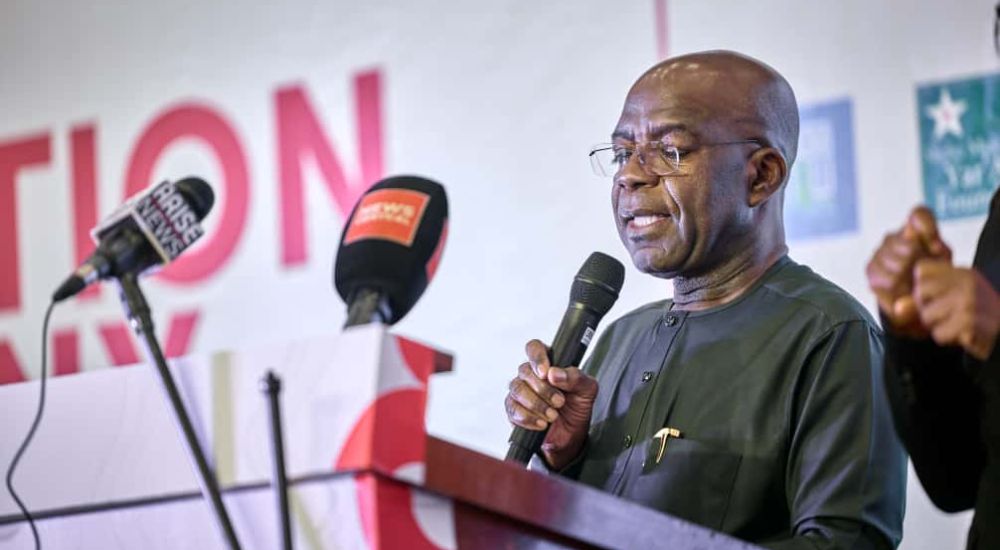
Oyebanji took the oath of office on Friday at the Ekiti Parapo Pavilion in Ado-Ekiti, becoming the first governor in the state’s history to secure consecutive terms since its creation in 1996. Chief Justice of Ekiti State, Justice Adekanye Ogunmoye, administered the oath to Deputy Governor Monisade Afuye at 1:27 p.m. before swearing in the governor at 1:35 p.m.
The ceremony attracted Vice-President Kashim Shettima, representing President Bola Tinubu; Senate President Godswill Akpabio; serving governors; traditional rulers; political leaders; and former Ekiti governors Ayodele Fayose, Segun Oni and Kayode Fayemi.
The political symbolism was unmistakable. Oyebanji had broken the state’s longstanding pattern of governors failing to secure consecutive mandates, winning re-election with 319,224 votes against 40,543 for his closest challenger, Peoples Democratic Party candidate Oluwole Oluyede, in the June 20 governorship election.
But an overwhelming electoral victory is not a certificate of exceptional governance. Neither does it absolve an administration of scrutiny.
Oyebanji has secured another four years in office. The question now is whether he can justify the confidence voters placed in him or whether his second term will become another exercise in celebrating government statistics while the economic frustrations of ordinary people persist.
Revenue Is Rising, But Where Is The Prosperity?
The administration’s strongest argument for continuity is its reported improvement in internally generated revenue.
When Oyebanji assumed office in October 2022, Ekiti’s monthly internally generated revenue reportedly averaged between ₦650 million and ₦700 million. By 2026, the government said the figure had risen to approximately ₦2.6 billion monthly, with cumulative revenue of ₦88.4 billion over four years.
Data attributed to the Joint Revenue Board also showed that Ekiti recorded a 62.13 per cent increase in internally generated revenue in 2025, outperforming other states in the South-West.
These figures, if sustained, represent a significant fiscal improvement. But revenue generation is a means to an end, not an end in itself.
The central question is what residents have received in return for the additional money flowing into government coffers.
Are more graduates finding decent employment? Are small businesses expanding? Have rural communities gained reliable access to healthcare, clean water, electricity and passable roads? Can households afford basic necessities without sinking deeper into financial distress?
A government cannot indefinitely use increased revenue as evidence of success without demonstrating how that revenue has improved people’s lives.
Ekiti’s economy may be expanding on paper, but the critical test is whether that growth is creating opportunities beyond the civil service and political establishment.
The administration must explain how its fiscal gains are translating into measurable improvements in household incomes, employment, productivity and access to essential services.
Economic Growth Without Enough Jobs
Unemployment remains one of the most uncomfortable tests facing the governor.
Ekiti is home to several higher institutions, including Ekiti State University, the Federal University Oye-Ekiti and Afe Babalola University. Every year, these institutions produce graduates who must compete for limited opportunities in an economy with a relatively narrow industrial base.
A reported unemployment rate of 32.21 per cent points to the scale of the challenge, although the underlying dataset and definition need to be examined before the figure is treated as a current, directly comparable measure.
The reported 2026 state recruitment exercise, which attracted 48,000 applicants for 2,000 positions, offers another indication of the pressure on formal employment opportunities.
For every available position, dozens of applicants were competing for a place.
This is not merely a recruitment problem. It reflects an economy struggling to absorb its workforce.
The government may point to agricultural initiatives, infrastructure contracts and proposed technology investments, but the crucial question is how many sustainable jobs these interventions have created, how many pay decent wages and how many will survive beyond government-supported programmes.
Engaging 5,000 young people in commercial farming is commendable if the initiative delivers measurable results. However, it cannot by itself resolve the employment crisis confronting a state with thousands of graduates and underemployed workers.
Ekiti needs a stronger private sector, agro-processing industries, investment in manufacturing, better access to finance for small businesses and an economic environment that allows enterprises to grow without excessive dependence on government patronage.
Without these changes, the state risks producing graduates whose principal ambition is to secure a government job or migrate elsewhere in search of a livelihood.
That would be a damning indictment of a development model unable to convert education into economic opportunity.
Poverty Figures Do Not Tell The Whole Story
The administration can point to Ekiti’s reported multidimensional poverty rate of 9.5 per cent in the 2026 Global Multidimensional Poverty Index briefing, placing the state among those with comparatively low rates.
But such a statistic should not become an excuse to dismiss the economic difficulties experienced by residents.
Multidimensional poverty measures different dimensions of deprivation and should not be confused with income poverty. The methodologies, reference periods and populations covered by different poverty assessments must be considered before their results are compared.
More importantly, a favourable statewide indicator does not mean that every household is doing well.
Residents continue to face questions about purchasing power, the cost of food, access to healthcare, employment and the circulation of money within local communities.
A teacher interviewed ahead of the election acknowledged improvements in agriculture and roads but expressed deep dissatisfaction with security and the broader economic situation. Other residents pointed to unemployment, underemployment and the continued migration of young people to larger cities.
These experiences expose a gap that government statistics alone cannot settle.
The administration must demonstrate that economic gains are reaching households outside government offices, politically connected businesses and selected project locations.
If revenue increases substantially while many families remain unable to meet basic needs, the government must explain why its growth has not translated into more widely shared prosperity.
Roads, Airport And The Question Of Priorities
Oyebanji’s administration says it awarded road contracts worth more than ₦200 billion, covering approximately 350 kilometres across the state’s 16 local government areas.
Of that distance, 126 kilometres were reported to have been completed, with the remaining projects at different stages of construction.
The government has highlighted the 17.8-kilometre Ado-Ekiti Ring Road Phase One, the 1.2-kilometre Bola Ahmed Tinubu Flyover at Okeyinmi-Ijigbo and the 19.8-kilometre Ado–Iworoko–Ifaki dual carriageway.
It has also celebrated the completion of the Ekiti Agro-Allied International Cargo Airport, on which the administration says ₦49.77 billion was spent. Commercial flight operations reportedly commenced in December 2025.
These are substantial investments, but the existence of major projects does not settle questions about their economic value, cost-effectiveness or distribution.
How much traffic is the airport attracting? What cargo volumes are being handled? How much revenue is it generating? What measurable benefits has it delivered to farmers, exporters and local businesses? What are its continuing operating and maintenance costs?
An airport’s economic value cannot be established simply by announcing that flights have commenced.
Its long-term justification depends on utilisation, reliable demand, cargo throughput, connectivity and the economic activity it stimulates.
The same scrutiny should apply to road construction. Residents in rural communities need to know whether their access roads are improving and whether completed projects are durable and adequately maintained.
Opposition figures have questioned the distribution of infrastructure projects and argued that some rural roads remain in poor condition. They have also questioned whether projects presented as government achievements were funded wholly by the state or supported by development partners.
Those claims should be tested against contract documents, project records and independent assessments.
The public deserves a clear account of project costs, funding sources, completion status and measurable benefits—not just a list of impressive contract figures.
Security: Peaceful State Or Unanswered Questions?
Security is another area in which the administration must confront uncomfortable questions.
The government has presented Ekiti as a relatively peaceful state, but critics have raised concerns about kidnappings and the response to security incidents.
In April 2026, Oluyede accused the administration of prioritising politics over the safety of residents. Reports also cited a case in which residents of Eda-Oniyo reportedly raised ₦25.2 million in ransom for abductees.
Other allegations concerned victims who were reportedly held in captivity for more than 35 days.
These accounts and the opposition’s characterisation of the government’s response require independent verification. Allegations should not be treated as proven findings, and the government’s position must also be considered.
Nevertheless, the concerns raise legitimate questions about the effectiveness of security operations, intelligence gathering, emergency response and support for victims and their families.
A state cannot establish its security record solely through declarations that it is peaceful. Residents must be able to live, farm, travel and conduct business without fear of abduction or violence.
Oyebanji’s second term should therefore be judged by verifiable security outcomes: the frequency and location of incidents, response times, arrests and prosecutions where appropriate, protection of vulnerable communities and the ability of residents to pursue their livelihoods safely.
Security is not a public relations contest. It is a basic obligation of government.
Fiscal Transparency Is Not The Same As Good Governance
Ekiti’s performance in BudgIT’s State Fiscal Transparency League has been one of the administration’s strongest selling points.
The state reportedly scored 100 out of 100 in the fourth quarter of 2024 and maintained leading positions through 2025. It also received a 72 per cent score in the 2025 Sub-national Audit Efficacy assessment.
The publication of budgets for all 16 local government areas and 22 local council development areas is another development the government has highlighted.
These achievements matter. Public access to budget information and credible audit processes can strengthen accountability.
But transparency is not synonymous with effective governance.
Publishing a budget does not automatically mean that projects are completed on time, money is spent efficiently or public services improve. An audit score does not, by itself, establish that residents are receiving value for money.
The more demanding questions concern implementation.
How much of the approved capital expenditure was actually released and spent? Were projects delivered at the contracted cost? Were procurement procedures followed? What did independent inspections reveal about construction quality? Were audit findings addressed?
The administration has also stated that it did not borrow to finance projects during its first term. Data attributed to the Fiscal Responsibility Commission reportedly put Ekiti’s domestic debt at approximately ₦43 billion in 2025, down from about ₦118 billion in 2022.
That reduction would be significant if the figures are comparable and the underlying liabilities have been comprehensively accounted for.
The government should publish sufficient documentation to explain the movement in debt, including repayments, new obligations and any relevant changes in classification.
Ekiti deserves not only transparent figures but also demonstrable value from public spending.
The Knowledge Zone: Promise Or Another Long Wait?
Oyebanji’s second-term agenda places considerable emphasis on agricultural industrialisation and the Ekiti Knowledge Zone, a proposed technology and innovation hub intended to attract start-ups, research institutions and technology companies.
The project has secured reported financing of $80 million from the African Development Bank, alongside $14.8 million in counterpart funding from the Ekiti State Government. The administration says it could generate more than 100,000 jobs upon completion.
If properly implemented, the project could help diversify Ekiti’s economy and create opportunities for young people in technology, research, digital services and innovation.
But the projected employment figure must be treated as a target, not a job creation achievement.
The project has been discussed for years, with financing approved in 2022 and construction reportedly commencing in 2026. That history makes implementation and delivery timelines particularly important.
How many firms have committed to operating from the zone? What proportion of the financing has been disbursed? When will the facilities become operational? What incentives will attract businesses? How many jobs are expected during construction, and how many permanent positions will exist once the project is running?
The government must also explain how local graduates and entrepreneurs will gain access to the opportunities being promised.
Without credible private-sector commitments, transparent implementation and a realistic operating model, the Knowledge Zone risks becoming another expensive infrastructure project whose projected benefits remain on paper.
Ekiti cannot afford to confuse the announcement of a technology hub with the creation of a technology economy.
Agriculture Must Move Beyond Announcements
Agriculture remains central to Ekiti’s economy, and the administration has reported engaging more than 5,000 young people in commercial farming through cluster initiatives.
The government has also promoted aggregation facilities, including the Ilu Eye Aggregation Hub, and retail interventions such as Ounje Ekiti, intended to improve food access and affordability.
These initiatives may provide useful foundations, but their success must be measured by outcomes rather than programme descriptions.
How many farmers have increased their incomes? How much produce is being processed locally? What proportion of agricultural output reaches markets without substantial post-harvest losses? How many stable jobs have been created in processing, storage, transportation and distribution?
A claim that Ekiti has the lowest food inflation rate in the country, attributed to National Bureau of Statistics data, also requires clear identification of the relevant reporting period and indicator.
Food inflation measures the rate of price increases; it does not necessarily mean food is affordable or that households have enough money to buy it.
A lower inflation rate can coexist with high food prices when prices have already risen substantially.
The government must therefore demonstrate whether agricultural policies are increasing production, improving farmers’ incomes and making food more affordable in practical terms.
The objective should be a productive agricultural economy that generates sustainable livelihoods, not simply a collection of initiatives that sound impressive at official events.
A Second Term With Fewer Excuses
Oyebanji’s inauguration theme, “The Good Work Continues,” signals his intention to sustain existing programmes and accelerate development.
His administration has identified healthcare, electricity, road infrastructure, water supply, agriculture and human capital development as priorities.
But the political circumstances of the second term are different.
Having won re-election decisively, the governor has a stronger mandate and fewer electoral uncertainties to navigate. He also has less room to blame his predecessor for inherited problems or present every continuing programme as a new achievement.
The coming four years should be about delivery, measurable outcomes and accountability.
The government must show that its revenue gains can support better public services, that its agricultural investments can create sustainable jobs, that the Knowledge Zone can attract functioning businesses and that infrastructure projects can generate economic activity beyond their construction phases.
It must also demonstrate that security concerns are being addressed and that public spending reaches communities according to transparent priorities.
The most important question is whether Ekiti can move from an economy heavily dependent on government activity to one capable of sustaining private enterprise, productive employment and broader prosperity.
That transition will require more than roads, official statistics and inauguration speeches.
It will require a deliberate strategy for industrial development, skills, investment, agricultural value chains and enterprise growth, supported by transparent implementation and measurable targets.
The Verdict Will Be Written By Ordinary Ekiti Residents
Oyebanji’s first term produced reported improvements in revenue generation, infrastructure investment and fiscal transparency. Those achievements deserve scrutiny and recognition where independently verified.
But they do not settle the larger argument over his performance.
The administration’s economic claims must be weighed against the realities of unemployment, living costs, limited private-sector opportunities and persistent concerns about security.
The governor has now secured something none of his predecessors achieved: a consecutive second term. That is a political milestone, but it is not necessarily a development milestone.
The danger is that the administration could mistake electoral dominance for public satisfaction, rising revenue for shared prosperity and completed infrastructure for economic transformation.
Ekiti residents will ultimately judge the government by what changes in their lives. Can young people find decent jobs without leaving the state? Can farmers earn more from their produce? Can small businesses grow? Can families afford food and healthcare? Can residents travel and work without fear?
These are more consequential measures of governance than the applause that accompanies an inauguration.
Oyebanji has four more years to prove that the promise of continuity means more than the continuation of his administration.
If he can turn revenue gains into productive jobs, infrastructure into economic opportunity, agriculture into sustainable wealth and public spending into better services, his second term could establish a lasting legacy.
If he cannot, the state’s historic re-election result may ultimately be remembered as a political triumph that failed to deliver a comparable transformation in the lives of its people.
The ceremony is over. The mandate has been renewed. Now Ekiti needs results—not another four years of promises.












 English (US) ·