
 1 hour ago
1
1 hour ago
1
By Aderogba George
The Advancing Children’s Rights Initiative (ACRI) says a three-month literacy intervention reduced the proportion of 120 Almajiri children in six Local Government Areas (LGAs) of Kano unable to identify letter sounds from 78 per cent to zero.
ACRI Programme Manager, Mubarak Haruna, disclosed this in a statement made available to the News Agency of Nigeria (NAN) on Sunday.
He said the programme, implemented with Universal Learning Solutions (ULS) and the National Commission for Almajiri and Out-of-School Children Education, used the Jolly Phonics approach.
Haruna said assessment results showed significant improvement in the children’s ability to recognise letter sounds and read English words.
He said 33 per cent of the children could identify at least 31 English sounds after the intervention, compared with none at the beginning of the programme.
According to him, word-reading skills also improved, with the proportion of children unable to read any English words falling from 86 per cent at baseline to 35 per cent at endline.
He said 17 per cent of the children could read at least 31 English words by the end of the programme.
Haruna said the children demonstrated the skills they acquired during the National Literacy Challenge for Almajiri and Out-of-School Children held on Sept. 19 at Baba-Ahmed University, Kano.
He said the children demonstrated letter-sound recognition, word segmentation and writing, sound blending, identification of tricky words and shared reading.
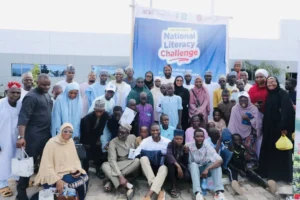
The programme manager said the event brought together government representatives, education stakeholders, development partners, civil society organisations, teachers and community representatives.
He said the challenge also featured a presentation on the Jolly Phonics pilot, a keynote address, a Child Voice Session and a panel discussion on Mallam and community engagement in children’s education.
Haruna said 650 books and other learning materials were provided to support continued learning by the children.
He said participating schools, teachers and School Support Officers were also recognised for their contributions to the programme.
According to him, the results showed the importance of measuring not only children’s enrolment and participation in education but also the skills they acquire.
He called for stronger collaboration among government institutions, development partners, civil society organisations, education practitioners, researchers, foundations, the private sector and communities to expand literacy interventions for underserved children.
He said sustained investment in literacy programmes was necessary to ensure that children who had been excluded from formal education could acquire foundational skills needed for further learning. (NAN)
Edited by Tosin Kolade








 English (US) ·